
Hunt County Court Records After Arrest
The arrest-to-court path starts with booking at the Hunt County Detention Center. The jail record may show the arrest charge, arrest agency, bond type, and bond amount, but that is not the final court record. Prosecutors and courts may later file, amend, reduce, dismiss, indict, or dispose of charges differently from the booking label. That is why court records after a Hunt County jail arrest should be checked through both jail and court channels.
The Hunt County District Attorney represents the State in felony criminal cases in Hunt County. The DA page identifies Noble D. Walker as district attorney and links to county case search, the county inmate search, TDCJ inmate search, TDCJ Victim Services, and VINELink. For custody and booking detail, use Hunt County jail inmate records. For booking photos, use Hunt County jail mugshots.
Find Hunt County Court Records After Arrest
Start with the jail roster when the arrest is recent. It can give the name, booking date, visible charge text, arresting agency, and bond information. Then check the court side. Hunt County uses Odyssey Public Access for public access categories that include court, jail, law-enforcement, incident, and payment paths. The full ASP.NET fields were not inspectable in the research environment, so use the official portal without assuming unverified field labels.
- Search the jail roster first for the person's booking date and visible charge text.
- Open Hunt County Odyssey Public Access and search by defendant name or case number if known.
- Use the county docket page for court settings by court and date.
- Match the court case to the person, charge, filing date, and court before relying on the result.
- Contact the relevant clerk for copies, certified records, or older files.
The Odyssey landing page is an official access point for several Hunt County record categories. It should be treated as a records portal, not as a custody confirmation line.
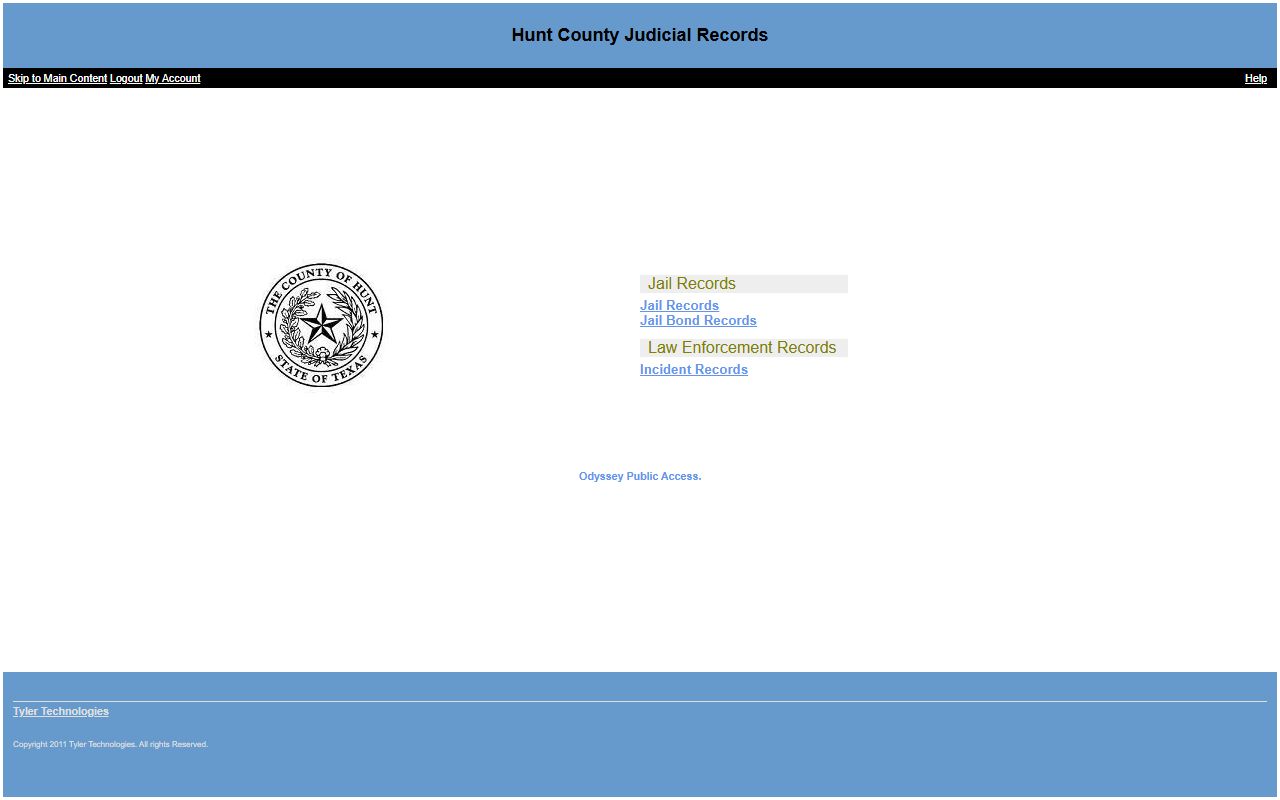
The portal is useful after the case has reached the court system. If a fresh arrest does not appear there yet, the case may still be waiting for prosecutor review or formal filing.
Hunt County Docket Search Fields
The county-hosted docket search is a separate tool for court settings. It uses a court dropdown and a date field, and the page says that dates should be formatted as MM/DD/YYYY or YYYY-MM-DD. Leaving the date blank searches the next 30 days. This is helpful when a person has a court setting after booking.
| Field Label | Type | Required | Options or Notes |
|---|---|---|---|
| Select Court | Dropdown | Yes | County Court at Law #1, County Court at Law #2, 196th District Court, 354th District Court, Justice Court 2 |
| Date | Text/date | Optional | MM/DD/YYYY or YYYY-MM-DD; blank searches next 30 days |
| Search | Button | n/a | Submits the docket query |
The Hunt County docket search screen shows the court dropdown and date instructions.
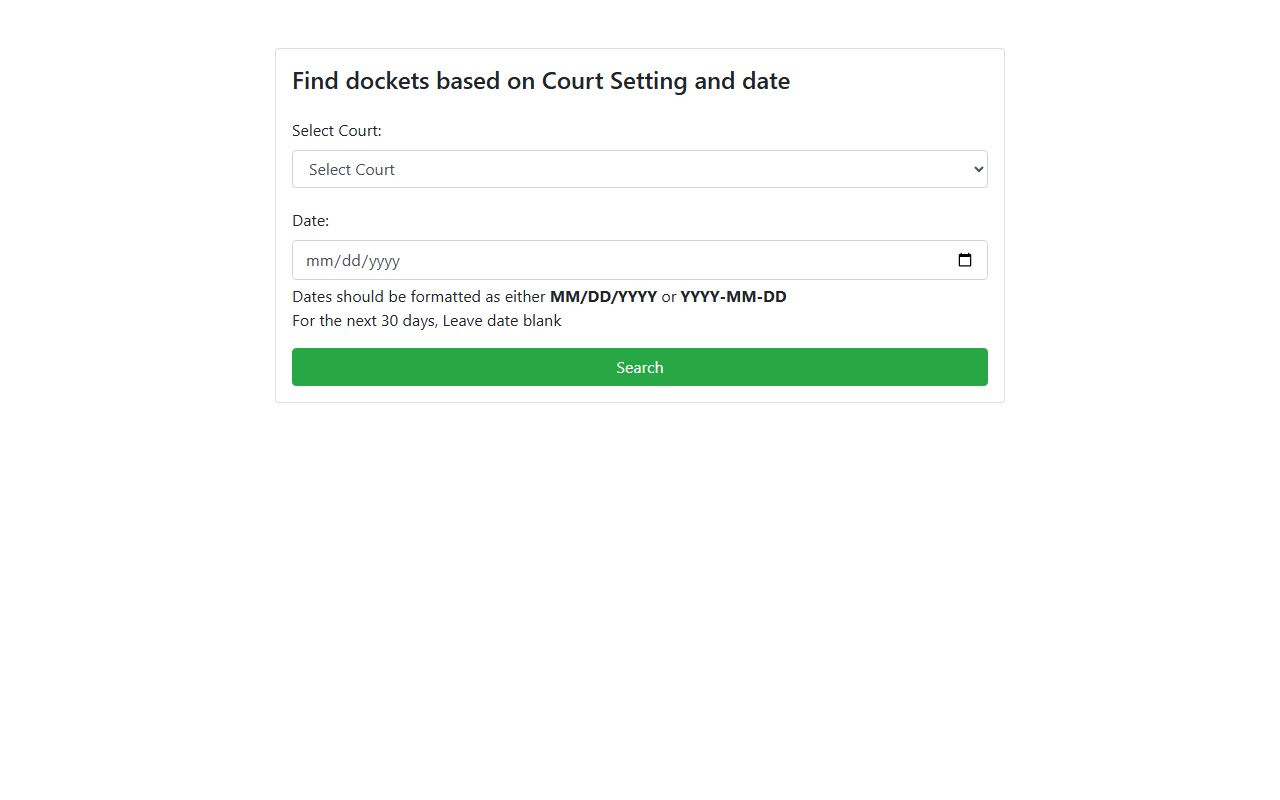
Use the docket tool to check settings, not to replace the court case portal or clerk copy request.
Hunt County Arrest to Court Routing
Felony cases are tied to district-court and District Attorney routing. Misdemeanor cases often move through County Court at Law paths. Justice Court settings may apply to lower-level matters or certain local proceedings. The District Clerk page links to court-record search functions for district-court records, while the County Clerk request page is limited to records maintained by that office.
The courthouse and jail are also separate places. The jail and Sheriff's Office are at the Stuart Street complex. The courthouse is at 2507 Lee St. in Greenville. A custody question belongs with the jail information line. A court copy or case-status question usually belongs with the clerk or court tied to the filed case.
Charges Filed After Hunt County Arrest
After an arrest, the booking charge may be only the first public label. The charging document is what starts or frames the court case. Texas criminal cases can involve a complaint, an information, or an indictment depending on the offense level and procedure. A prosecutor may also decline, amend, reduce, or add charges after reviewing the arrest file.
| Document | Who Uses It | What It Means |
|---|---|---|
| Complaint | Often officer or prosecutor supported | A sworn allegation commonly used early in the process |
| Information | Prosecutor | A prosecutor-filed charging document, common for misdemeanors and some waived-indictment contexts |
| Indictment | Grand jury | A felony charging instrument returned by a grand jury |
| Jail charge | Booking record | A custody label, not a conviction and not always the final court charge |
Hunt County Charge Status Terms
Charge status can change as a case moves. A pending charge is not a conviction. A dismissed charge is not the same as an expunged record. An amended charge may use different wording from the jail roster. Court records after an arrest should be read with the latest docket entry, charge list, and disposition.
| Status | What It Means |
|---|---|
| Pending | The charge has not reached final disposition |
| Amended or reduced | The filed charge changed after review, plea, or court action |
| Dismissed | The charge was dropped by court order or prosecution action |
| Convicted | The person was found guilty or entered a plea accepted by the court |
| Deferred | The case may have conditions and later disposition rules that need clerk verification |
Bond Records After Hunt County Arrest
Bond information can appear on the booking profile by charge row. The inspected Hunt County profile showed bond type and bond amount fields, with a sampled surety abbreviation. Texas Code of Criminal Procedure article 15.17 governs the first appearance and magistrate warnings after arrest. Article 17.15 supplies the rules for fixing bail, including appearance assurance, non-oppression, offense circumstances, ability to make bail, and safety.
| Bond Type | How It Works |
|---|---|
| Surety bond | A licensed bondsman posts the bond for a fee and guarantees appearance |
| Cash bond | The full amount is paid directly where accepted by the jail or court |
| Personal or PR bond | Release is based on promise and conditions rather than full cash or surety |
| No-bond hold | A charge, warrant, parole hold, immigration detainer, or outside agency may prevent release |
Use the Hunt County Bail Bond Board and the county bail-bond company page for official local bond-company information. Confirm active bond eligibility with the jail because online data can lag.
Warrants Before a Hunt County Arrest
No standalone official Hunt County Sheriff active-warrant search page was located in the sheriff navigation during the research pass. That does not mean warrants are unavailable through every channel. If a warrant has been served, the person may appear on the current jail roster. Bench warrants and capias warrants often connect to court cases, so Odyssey Public Access and docket tools may be useful after a case exists.
- Arrest warrant
- A court or magistrate order authorizing arrest.
- Bench warrant or capias
- A court-issued warrant, often tied to failure to appear or a court-order violation.
- Detainer
- A hold from another county, state, federal, parole, or immigration authority.
Charges vs Convictions
A charge is an accusation. A conviction is a court outcome. Hunt County court records after an arrest can show both pending charges and final dispositions, but a booking row by itself should not be read as proof that a person was convicted.
| Point | Charge | Conviction |
|---|---|---|
| Stage | Filed accusation or booking allegation | Final plea, verdict, or accepted finding |
| Source | Jail roster, complaint, information, or indictment | Court judgment or disposition |
| Can change? | Yes, charges may be amended or dismissed | Can still be appealed, sealed, or affected by later orders |
Sealed and Expunged Arrest Records
Texas Code of Criminal Procedure Chapter 55 governs expunction of eligible arrest records. Expunction is a court process, not an automatic roster edit. If an arrest was dismissed, no-billed, acquitted, or otherwise eligible, the person should verify the order with the clerk and the agency holding the record. Sealing and expunction are different remedies, and eligibility depends on the case facts.
| Point | Sealed | Expunged |
|---|---|---|
| Public visibility | Hidden from most public access | Removed or treated as not existing for many purposes |
| Agency access | Some official access may remain | Very limited access after a valid expunction order |
| Hunt County step | Verify the court order with the clerk | Verify the order, then contact each agency that holds the record |
Restricted Hunt County Court Records
Some court records after an arrest may be limited by law, court order, juvenile status, active investigation, law-enforcement exceptions, or sealed-record rules. Texas Government Code Chapter 552 supports public access to government records, but section 552.108 allows certain law-enforcement information to be withheld. That same law-enforcement section is also why basic information about an arrested person, an arrest, or a crime remains an important public-access category.
Important: Do not use casual court or jail lookups for credit, employment, housing, insurance, or any other FCRA-covered decision.